
Granular Revolution: A Deep Dive into Micro-Sound Synthesis and the Future of Electronic Music
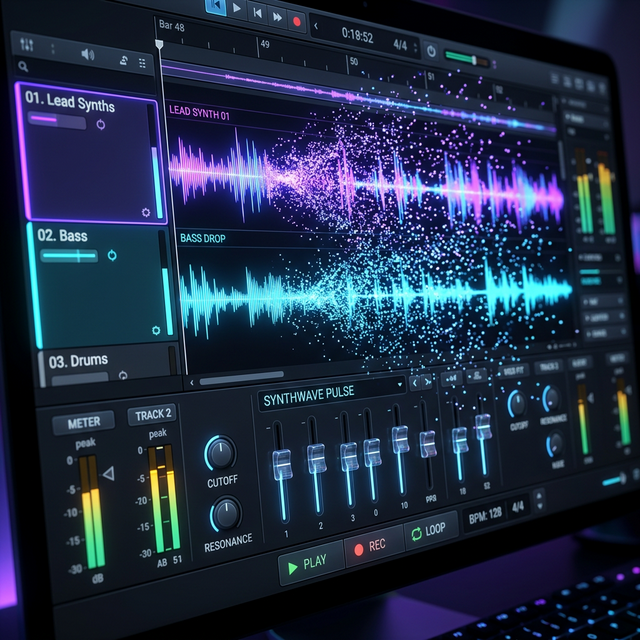
The Granular Revolution
What if you could take a single raindrop, freeze it in time, shatter it into a million microscopic fragments, and rearrange those pieces to create an ocean? This is not poetic exaggeration; this is the literal mechanics of Granular Synthesis. In 2026, we are witnessing a paradigm shift. Static waveforms are dead. The future belongs to those who can paint with the atoms of sound.
1. The Genesis of Micro-Sound: A Historical Wikipedia-Level Context
To master granular synthesis, you must understand its origins. The concept wasn't born in a modern DAW; it originated in the realm of quantum physics and avant-garde mathematics. In 1946, Hungarian-British physicist Dennis Gabor (who later won a Nobel Prize for inventing holography) proposed the concept of "acoustical quanta". Gabor argued that our hearing mechanism does not perceive sound merely as frequencies (Fourier analysis) or time (oscillograms), but as a matrix of time-frequency coordinates. He called these microscopic acoustic events "grains".
Iannis Xenakis and the First Implementation
It wasn't until 1958 that Greek-French composer and architect Iannis Xenakis applied Gabor's theory to musical composition. Xenakis composed Analogique A-B by literally cutting magnetic audio tape into tiny fragments (grains), each a fraction of a second long, and splicing them back together using stochastic mathematical models. What took Xenakis months with razor blades and tape, modern producers can now achieve in milliseconds.
In the late 1970s and 80s, computer music pioneer Curtis Roads formalized granular synthesis for digital systems, culminating in his seminal book Microsound. Roads categorized sound particles mathematically, paving the way for the VSTs and digital engines we use today. Understanding this lineage elevates your production: you aren't just twisting knobs; you are manipulating the quantum mechanics of audio.
2. The Anatomy of a Grain: Deep Technical Dissection
Standard wavetable synthesis oscillates continuous waves. Granular synthesis operates on a completely different paradigm: it samples a microscopic snippet of audio (the grain), plays it back, and continuously overlaps thousands of these grains.
Grain Duration & Rate
A typical grain lasts between 1 to 100 milliseconds. If the grain is under 20ms, the human ear loses the ability to discern its pitch, perceiving it as a percussive "click" or pure texture. Above 20ms, pitch information returns.
- > 50ms: Cloud textures, pads
- > 20ms: Metallic, vocal splices
- < 10ms: Noise generators, glitch artifacts
The Envelope (Windowing)
If you simply cut audio, you create harsh zero-crossing clicks. To fix this, granular engines apply an amplitude envelope (or "Window") to every single grain.
Hanning / Gaussian: Smooth, bell-like curves. Perfect for lush ambient pads.
Rectangular: No smoothing. Results in aggressive, harsh industrial glitch textures perfect for neurobass.
🎛️ Advanced Workflow Checklist
Apply this framework using Ableton's Granulator III or Arturia Efx FRAGMENTS.
Source Material Selection
Do not use pure sine waves. Granular thrives on harmonic complexity. Use field recordings (breaking glass, rain), complex vocal chops, or heavily distorted foley. The richer the harmonic spectrum, the better the granular clouds.
Stochastic Modulation (Spray / Jitter)
Static granular sounds robotic. Introduce 'Spray' (randomness in grain starting position). Map an LFO to the Grain Position with a slow rate (0.1 Hz) to create a constantly evolving, "breathing" texture that never repeats.
Asynchronous Pitch Shifting
Unlike traditional samplers, granular engines divorce pitch from time. You can pitch a vocal down 2 octaves without slowing it down. Introduce slight random pitch variations (±0.05 semitones) per grain to create a massive, wide chorus effect natively.
The WBBT Perspective
At WBBT Records, we actively seek producers who push the boundaries of sound design. Over-reliance on Splice loops is saturating the market. By mastering granular synthesis, you generate timbres that literally nobody else in the world possesses. It transforms you from a beatmaker into an acoustic architect. If you've created a masterpiece using these deep micro-sound techniques, submit your demo to us. We're looking for the future, not the past.
Beatport Distribution →
Get on Beatport, full Beatport Pro catalogue for electronic music